Endodontics · saving the tooth
Endodontics in Jerez
When a cavity, a blow, or an infection reaches the nerve of the tooth, a root canal allows us to save it instead of extracting it. We perform the procedure using a microscope for greater precision and with anesthesia so you won't feel any pain.
or call us at 956 339 083
What is endodontics?
Endodontics is the branch of dentistry that prevents, diagnoses, and treats diseases of the dental pulp, the tissue inside the tooth that provides it with nutrition and sensitivity. When the pulp is damaged or inflamed, due to deep decay, trauma, or infection, endodontics saves the tooth: it removes the affected tissue and seals the interior, allowing the tooth to retain its function and appearance.
«Endodontics not only saves your teeth, but also takes care of your long-term oral health.»
What can happen to the pulp?
From least to most serious
Inflamed pulp
It hurts with the cold or the heat, and the pain takes a long time to go away.
Dead pulp
The pain may stop, and sometimes the tooth darkens.
Root infection
An abscess forms at the tip of the root.
The most common signs
Just one is enough for the dentist to check it.
- It hurts a lot with the cold or the heat, and the pain stays for a while.
- You have pain for no reason, or the pain wakes you up at night.
- It hurts when you bite or touch the tooth.
- One tooth has darkened, especially after a blow.
- You have a pimple on your gum, next to the tooth.
A toothache that stops hurting isn't always a good sign: sometimes it's because the nerve has died. If there was an infection, it's still there and should be treated.
Why does the pulp get damaged?
These are the most frequent causes.
A deep cavity
If left untreated, tooth decay progresses until it reaches the nerve and infects it.
Bruises and fractures
A blow, even an old one, or a break can damage the pulp.
Cracks
A small, sometimes invisible, crack allows bacteria to pass inside.
Large or repeated fillings
A tooth that has been repaired many times is more exposed.
Diseased gums
A deep pocket in the gum can reach the root and affect the nerve.
If you let it go
A damaged pulp does not heal on its own. The infection can spread to the root tip, forming an abscess or phlegmon and destroying the bone. Treated promptly, root canal therapy saves the tooth; if you wait too long, there may be nothing left to save.
Keeping your own tooth, when possible, is always the first option.
Inflamed pulp
Endodontics: the tooth is preserved
Root infection
Abscess or phlegmon
If too much is lost
Extraction and implantation
Does a root canal hurt?
No. It's done with local anesthesia, so you shouldn't feel any pain during the treatment. In fact, root canal treatment is what relieves the pain of an inflamed nerve. To make it comfortable:
- We work with a microscope, with greater precision and in less time.
- Often it is completed in a single appointment; if there is an infection, another appointment may be necessary.
- We'll explain each step before we begin.
- If you're scared, tell us: we'll go at your pace.
- Then we'll give you instructions and check you out.
If you are a new patient, the first visit and diagnosis are free.
or call us at 956 339 083
If it hurts a lot now
Call us and we'll find you a slot.
- Avoid chewing on that side.
- Avoid things that are too cold and too hot.
- Do not take antibiotics you have at home.
- If your gums or face swell, it could be an abscess: make an appointment as soon as possible.
After root canal treatment
- It's normal to notice the tooth is somewhat sensitive when biting for a few days.
- Do not eat until the anesthesia wears off.
- Chew on the other side until we rebuild the tooth.
- Don't miss your reconstruction appointment: a tooth that has undergone root canal treatment is more likely to break.
- Brush your teeth normally, including that area.
If your face swells, you develop a fever, or the pain worsens instead of subsiding, don't wait for a checkup: Call us at 956 339 083.
How we perform a root canal at RBG Clinic
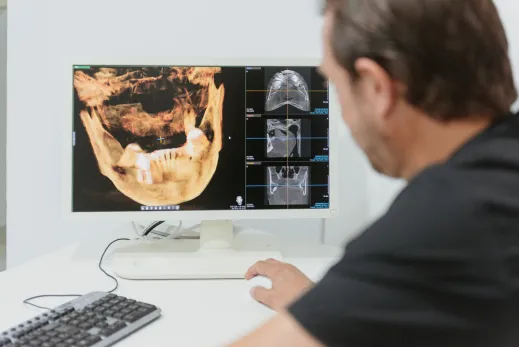
First, we examine the tooth and take an X-ray to see the pulp and root. Then we explain the treatment and its cost so you can decide before we begin.
«Thanks to microscopic endodontics, we achieve more precise, safe, and effective treatments.»
01
Diagnosis
We'll see how far it goes.
We examine the tooth and take x-rays to check the condition of the pulp, the root canals, and whether there is an infection.
02
Microscope
We cleaned the interior
Under anesthesia and with the operating microscope, we remove the damaged pulp and clean each root canal with millimeter precision.
03
Sealed
We closed the ducts
We fill and seal the ducts so that bacteria cannot re-enter and the infection does not recur.
04
Reconstruction
We restore strength to the tooth
A tooth that has undergone root canal treatment is more fragile, so we rebuild it and, if it has lost a lot of tooth structure, we protect it with a cap to make it last.
Why choose RBG Clinic?
Root canals are performed by Dr. Juan Luis Garrido, an endodontist and head of the restorative and conservative dentistry department, using an operating microscope. First-time patients receive a free consultation and diagnosis, and you can finance your treatment for up to 24 months interest-free.
+25
years in the sector
+25 000
patients
Free
the first visit, if you are a new patient
What other patients say about Dr. Rábago
Some of our customers would like to share their experiences.
5 reviews
I'm in Jerez de la Frontera on vacation, and on my first day I had a problem with a tooth. I called the clinic, and they were kind enough to see me that same day and fix the problem so I could enjoy my two-week vacation. Excellent service and treatment. A perfect experience.
A.MExcellent personal and professional attention. Unmatched clinical professionalism. In all my consultations, I've left with top-notch procedures and no complications whatsoever.
Jose Manuel Aranda LorenteI used to be terrified of going to the dentist, but since I started going to Dr. RBG's clinic, they have gradually helped me overcome that fear. The entire staff are wonderful and very professional.
Felicidad Pedraja AlcaideI always go there with complete confidence; they're very attentive to their patients! A great team, and Dr. Rábago is a true professional who gave me back my smile.
Paloma GallegosI'm so happy. They've done a perfect job on my teeth.
M.angel Ruiz RiosQuestions about endodontics
These are the questions you ask us most often before a root canal. If yours isn't listed, Write to us.
What's better, a root canal or extracting the tooth and putting in an implant?
If the tooth can be saved, it's almost always best to keep it: it's your tooth, with its root and gum. An implant is the solution when there's no way to save it. We'll tell you this clearly after evaluating your case.
How many sessions are needed?
Many root canals are completed in a single appointment. If there is an infection or the tooth has complicated canals, a second appointment may be necessary. The restoration appointment follows.
Do I need to put a cover on afterwards?
Not always. If the tooth retains enough structure, it can simply be rebuilt. If it has lost a lot of structure, especially in molars, a crown is recommended to prevent it from breaking.
What are the advantages of doing it with a microscope?
The operating microscope magnifies and illuminates the image, allowing us to see canals that might be missed with the naked eye. This leads to more precise results, faster and safer treatments, and helps preserve more healthy tooth structure.
Can a failed root canal be repeated?
Yes, in many cases. If an old root canal causes problems again, the inside of the tooth can be cleaned and resealed; this is called a re-root canal. We'll tell you if it makes sense in your case or if another option is better.
How much does a root canal cost?
It depends on the tooth: a molar has more canals than a front tooth, and a first root canal is not the same as a repeat treatment. If you're a new patient, the first visit and diagnosis are free, and we'll give you a detailed estimate before we begin. You can also finance it for up to 24 months interest-free.
Book an appointment at RBG Clinic
If you have a toothache or have been told you need a root canal, write to us or call us and we'll check it out.
Phone: 956 339 083
WhatsApp: 661 766 827
Schedule
Monday to Thursday: 9:30 a.m. to 2:00 p.m. – 3:00 p.m. to 6:30 p.m.
Friday: 09:30 – 14:00